
The Academic year has already started and we are looking to our presentation on Monday. Regardless of that, we are still continuing our outlook of the world’s largest emerging economies and their current situations as well as attractiveness for investment. This time it is the turn for our Eastern giant – Russia, a country that exposes high growth potential as well as attractiveness for investment.
The Russian economy has undergone massive changes since the fall of the Soviet Empire, transitioning from a state controlled, socialist structure to a more market-based and globally integrated economy. Economic reforms in the 1990s privatized most industries, and some energy and defence related sectors. In 1998 the country was severely hit by the Asian crisis a year before, whose unpredictable impact on the world commodity prices tumbled the economy. And, as the rouble was severely overvalued with respect to other currencies, it followed several devaluations until the Central Bank of Russia finally made it float. In just a few years the RUB/USD lost app. 85% of its value, dropping from 5 to 35.
Since the crash the Russian economy has shown an average real growth rate of approximately 5 per cent a year. Russia”s reserves have ballooned from practically zero in 1998 to $484.7bn today – the third largest haul on earth. The country is now almost debt-free – even the expected budget deficit of 3% of GDP makes the external debt of 9.5% look like a drop in the ocean, and a trade surplus almost twice as much again.
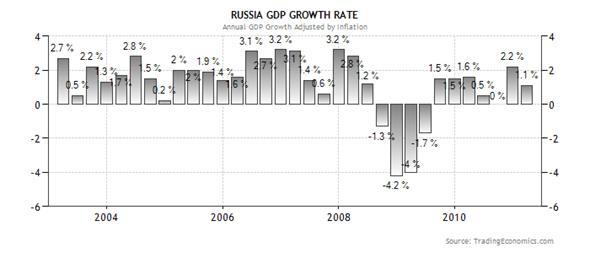 Russia’s annual real GDP growth rates. Source: tradingeconomics.com
At the same time Russia’s economic growth slowed in the first quarter as corporate investment stagnated and the biggest quarterly gain in oil prices (when the price exceeded 120$ per barrel) for two years failed to offset $21.3 billion of capital outflows.
In 2005, Russia overtook Saudi Arabia to become the world”s largest crude exporter. And the country”s post-Soviet recovery was initially built on a 50 per cent rise in annual crude production. However, its dominance in manufacturing cannot solely be limited to that: besides its resource-based industries, it has developed large manufacturing capacities, notably in metals, food products, and transport equipment. Russia is now the world”s third-largest exporter of steel and primary aluminum as well as a notable food exporter to the world.
But Russia is now far more than “just an oil and gas economy”. Retail sales are growing at around 13 per cent a year in real terms – one reason why leading multi-nationals are now piling into Russia. Construction is expanding by 16 per cent a year, and domestic investment by 20 per cent – as Om ervoor te zorgen dat je dit bedrag meteen weer uit laat betalen en het verlaat met dikke winst, is er een regel opgezet om dit tegen te gaan. Russia rebuilds its shattered post-Soviet infrastructure. Just look at the fancy-looking Moskva City, which is [still] being built with great resemblance to the city of London to become the largest financial centre in Eastern Europe and Asia. Again, this trend is now attracting massive foreign investment, pooling from every corner of the planet.
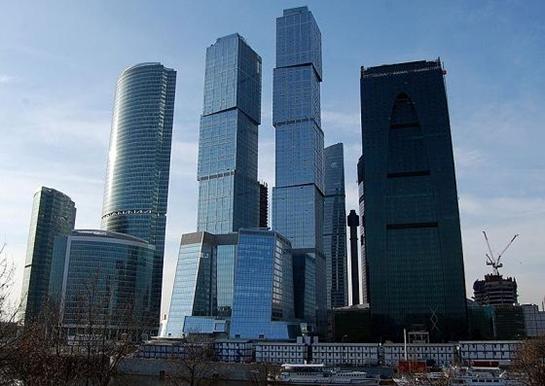 Moskva city: Russian megalomania is hitting unprecedented heights. Source: wordpress.org
Goldman Sachs describes Russia”s economic performance as “remarkable”. UBS calls it “awesome”. Russia, India, China and the other large emerging markets are upending the world economic order. The Telegraph remarks that “Their resurgence has created hundreds of billions of dollars of wealth and lifted tens of millions from poverty”. Western politicians struggle to adjust to these new realities – particularly when it comes to the old “Cold War” enemy. But Russia is now the world”s ninth largest economy – and rising fast. And, in my view, much of the scorn aimed its way is nothing but a small-minded reaction to this rapidly shifting balance of global power.
However, the euphoria claimed by many specialists was highly pronounced in the first half of the year as Russian stocks followed a dramatic rise to their highest levels before the 08-09 crisis reaching a peak at 2,025, which is also above the psychologically important barrier of 2,000. But now the tempers have been slightly dampened. Although foreign investors saw a strong appetite for Russian equity at the beginning of the year, the recent occurrences in Japan and the US plus the economic slowdown of Russian economy have seriously pushed their prices down. Now the index is crawling just above the 1580 level, a 12.4% loss as compared to the 2010 closing price.
Regardless of that, experts are still very optimistic about Russia’s future prospects. “We expect a pickup in growth in the second half, in part thanks to demand-driven investment,” the Russian Economic Ministry Deputy Andrei Klepach said. Agricultural output will also help growth accelerate after the worst drought in at least half a century in 2010 destroyed harvests. At the same time Russia’s growth is still lagging behind its peers, namely, the BRIC countries, hence more emphasis should be placed so as ensure even real growth with its main rivals in the forthcoming years. This is exactly what is happening now when increasing real wages ( 0.7% this month) bolster consumption habits among the people and help to „heat” the economy. The year-end projections for Russia with regards to GDP growth are 4.6%, a figure that looks somewhat underestimated given the growing level of economic activity in Russia.
Furthermore, the export structure of the country reveals strong evidence of the so-called Dutch disease. Russia is just too dependent on its oil monopoly in the world arena in such a form that it cannot even divert other kinds of industries (see graph of exports). Representatives of the IMF claim that Russia’s main issue is instability of economic development derived from extreme susceptibility to the changes in oil prices. The same is happening with investors: they feel overly optimistic when oil prices surge and the reverse when they fall.
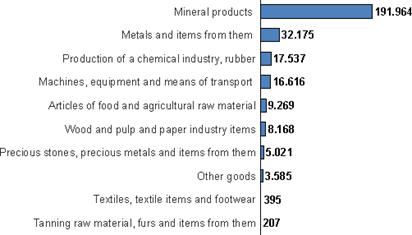 Russia’s largest export positions in Millions of USD. Source: aviapartners.eu
With the fallacies of Russia’s bureaucratic and largely corrupt business environment further development of new businesses might be severely impeded. Although a bit unrelated to physical good exports, recently the Russian was left by two major European banks, HSBC and UniCredit, which just could not resist the offsetting protectionist policies of the state to shield its two largest banks. If this is likely to continue, foreigners willing to invest could long be deterred from Russia.
Speaking of the ruble it is highly unlikely that it would depreciate in the forthcoming months, especially given Russia’s positive current account balances and oil prices that are starting to rise again. However, the estimates of Russian Ministry of Economy reveal that the current account surplus might turn negative in 2013-2014 as a result of increased both private and public spending, which, naturally, would foster demand for foreign goods.

