
The iFund board is pleased announce a cycle of weekly reviews devoted to the BRIC (Brazil, Russia, India, China) countries. These have been lately referred to as the countries with the highest growth potential which mainly derives high labour availability and low expenses, favourable conditions for investment as well as presence of natural resources. Hence, they are frequently called the next future big deal as people readily invest there for the hope of future growth. Over the next for weeks we will try to examine how these economies have managed to reach the state of a good bargain and seek to show whether such inflated optimism is justified in the real life. Our first article devotes itself to India, a country that managed an astonishing breakthrough over the last two decades and starts to cast doubt whether such rapid growth will last eternally.
India has been a country that has deserved relatively little attention in our hemisphere. Poverty, diseases, overpopulation and social instability: these are the most prevalent keywords that any average European citizen would recall of India given the “abundance” of news about this huge and multicultural state. Nevertheless, little do they know that the country has developed not only quantitative (population) terms but has also done its utter best to raise the standard of living and become a notable player in the world economy.
That all came to an end 20 years ago, on July 24th 1991, when Manmohan Singh, then minister of finance, facing a balance-of-payments crisis, told parliament that “the room for manoeuvre, to live on borrowed money or time, does not exist any more.” He attacked the prioritisation of producers over consumers, and swept away tariffs and the mesh of licences used to micromanage firms. The reforms were less dramatic than events in the Soviet Union—where a month later Boris Yeltsin stood on a tank and denounced an attempted coup—but also changed hundreds of millions of lives. Mr Singh’s speech marked India’s entry into global capitalism. He ended by paraphrasing Victor Hugo: “No power on earth can stop an idea whose time has come.”
The guy was right: the rupee faced severe devaluation, the limits and export quotas were abolished and for the first time India truly opened several industries to foreign investment. That idea, Mr Singh suggested, was India’s emergence as a “major economic power in the world”. The years since have amply vindicated his confidence. India’s economy has almost quadrupled in size, growing by about 7% a year on average over the past two decades and by over 9% from 2005 to 2007. Given India’s sheer scale, its economic rise is bigger than any that came before, bar China’s, and far bigger than anything that will come after.
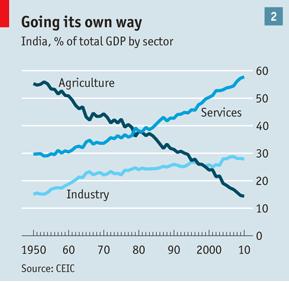 Breakdown of major sectors according to the share of GDP. Source: www.economist.com
As can be seen in the graph above, liberal reforms have also changed the structure of India’s economy, or so to say, facilitated the old trend started in the early fifties. Services have boomed and manufacturing has stagnated as a share of output (see chart 2), while most people still work informally and live rurally. India has world-class information-technology exporters but imports lots of fridges; it has 15 times more phone subscribers than taxpayers; and in the coming years most Indians are likelier to be connected to a national, biometric, electronic identity-system than to a sewer.
However, India has yet to encounter some more problems. India”s economy emerged from the Great Recession in better shape than China”s, despite its slightly lower growth rate. But now India looks like it”s running into choppy times as well, with frighteningly high inflation, big budget and trade deficits and weakening competitiveness versus China and other rivals. Price pressures have persisted long enough to cast doubt on the assumption that it can resume growth of 9% or more without overheating (see chart). An annual inflation rate of as much as 11.7% is projected until the end of the year, meaning that India’s rapid growth may be turned into a slump in real terms.
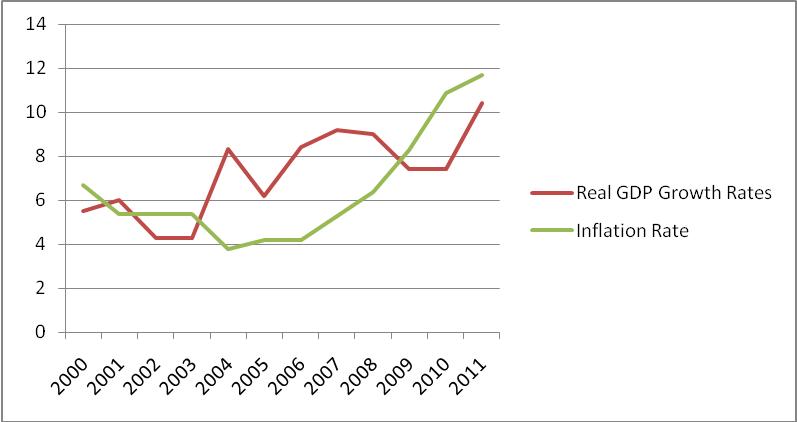 Indian real GDP and growth rates 2000-2011. Source: Reuters EcoWin
The recovery itself has been led
so far by portfolio and bank flows, with a falling share of foreign direct investment inflows. These developments mark a departure from earlier experience and may raise the risk of future instability, including capital outflows. However, during fall 2010 the capital-flow-driven rally in emerging market assets slowed again. Foreign investment has been patchy of late and even India’s indefatigable entrepreneurs seem disheartened.
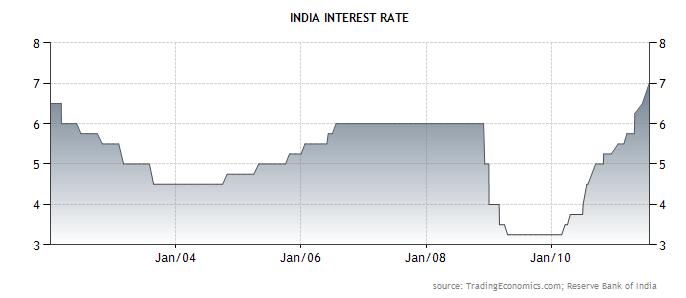 Indian benchmark interest rate (reverse repo). Source: www.tradingeconomics.com
The recent occurences in the economy call for an alerting “How long can India sustain such high growth rates?”. The situation honestly looks somewhat trembling for India: looking at the rapid growth of interest rate there is no wonder why Indian entreprenurs seem to be deterred from further investment activity. A 4 percentage point rise in interest rates well resembles the state in the macoreconomic cycle theory that the Indian economy is overheating and may be heading for a near downslide as the economic indicators are becoming by far less gloomy than they were before. Furthermore, such rise most likely comes from the government’s risk of default due to running budget deficit for the past few years.
Experts still remain rather favourable of India’s prospects: the economy will continue to be sustained in the short-term, as the effect of stimulus programs is yet to take and tax cuts are working their way through the system in 2010-2011. Due to the strong liquidity positions in the market, large corporations now have access to capital in the corporate credit markets. This may have an offsetting effect to the slowing growth pace of the country in the forthcoming months.
However, the main case of the day still remains the inability of government institutions to stop the demographic boom that persistently remains high. The Economist notes that India’s demographic momentum should inspire urgency not complacency. “Every year over 25m Indians enter the world and the labour force swells by 10m or more. Each year that passes without progress on malnutrition, schooling and hiring thus consigns millions of youngsters to marginal jobs, with little chance of realising their potential”. And without further reforms in social welfare, curbing population growth and diminishing social inequality and disparity are the tasks that the bright minds of India should have in their agenda for the forthcoming years if India is ever to become a powerful global player.

