
The iFund board continues its quest around the world exploring its most potent and rapidly growing economies. The second article is devoted to the an emerging giant of Latin America – Brazil, which despite multiple economic mishaps has established a strong and vibrant economy which is bound to be one of the leading forces in the forthcoming decades.
The Brazilian economy’s consistent and solid performance during the financial crisis and its strong and early recovery, including 2010 GDP growth of 7.5%, have contributed to the country’s transition from a regional to a global power. Expected to continue to grow in the 4% to 5% range in 2011-2015 according to the IMF, the economy is the world’s eighth-largest and is expected to crash into the top five most powerful economies of the world in several years.
During the administration of former President Lula, surging exports, economic growth and social programs helped lift tens of millions of Brazilians out of poverty. For the first time, a majority of Brazilians are now middle-class, and domestic consumption has become an important driver of Brazilian growth.
President Dilma Rousseff, who took office on January 1, 2011, has indicated her intention to continue the former president’s economic policies, including sound fiscal management, inflation control, and a floating exchange rate.
The markets also pose a largely supportive view of the prospects of the Brazilian economy. Even though the country has far fewer inhabitants than India or China, it is the leading constituent of the MSCI Emerging Markets Index, and has retained this position since 2008 outperforming the abovementioned countries plus a series of other fast-growing economies (Egypt, Mexico, Poland, South Africa, South Korea and so on).
Believe it or not, the country has numerous reasons for that. Brazil supplies the world with commodities and natural resources such as lumber and petrochemicals. Extensive deposits of iron, manganese, nickel, tin, uranium, bauxite, beryllium, copper, lead, tungsten, zinc, gold, and other minerals are important sources of industrial raw materials and account for a significant portion of export earnings.
The strength of Brazil is also associated with its oil reserves, thus it is widely regarded as the new “Persian Gulf” or “Oil superpower”. Newly discovered offshore oil deposits further brighten the country’s prospects going forward as foreign oil producers strive to enter this market and set their own oil platforms. In March 2011, the notorious British Petroleum entered a 7 billion deal with Devon to conduct field research and create oil platforms in the pre-salt regions of Brazil, which by 2020 would yield 1.82 million barrels of oil a day. Exxon Mobil and Petrobras now share the Santos basin, which contains more than 8 billion barrels of oil. From an economic perspective, feeding foreign oil giants with such an important resource is certainly unwise in the long run because of foregone profits to locals, and perhaps stricter government surveillance like in Russia or Venezuela should be undertaken
Brazil’s economic policies generally favor foreign investment. In fact, Brazil is the largest recipient of foreign direct investment in Latin America, with the United States as the top foreign investor.
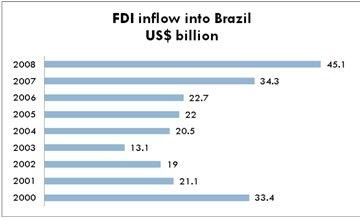 Foreign Direct Investment Inflow into Brazil 2000-2009. Source: investorsinsight.com
The country boasts one of the most advanced industrial sectors in all of Latin America. Industrial operations account for one-third of the nation’s GDP, with a diverse manufacturing base that includes automobiles and parts, machinery and equipment, shoes, textiles, cement, computers, aircraft, and consumer durables.
Brazil’s sophisticated and diverse services industry includes sectors such as telecommunications, energy, banking, commerce, and information technology. Brazil also prides itself on being a leader in science and technology in South America. Local universities spend a great deal of money by attracting foreign PhDs to conduct research in fields such as biofuels, agricultural research, deep-sea oil exploration, and remote sensing, where Brazil enjoys international recognition for its scientific contributions.
The country has also emerged as a leader in IT outsourcing in Latin America. Close time zones, physical proximity to the U.S., cultural compatibility, and cost savings on labor all make Brazil very attractive to companies looking to outsource tasks such as web design and programming.
Serious flaws on the way
The largest overhang to the Brazilian economy has been systemic inflation and structurally high interest rates. The current benchmark government-lending rate, the Selic, is yielding 12.50%; with inflation running around 6.9% that translates into 5.6% real rate of return. Far greater than almost everywhere except Greece and Portugal, yet the bewildering 12% interest rate is honestly a sign that the economy may be outpacing normal growth.
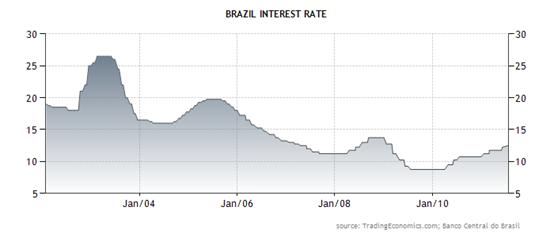 10-year government bond interest rates. Source: tradingeconomics.com
Given that Brazil has sound banking, monetary, and fiscal policy (in fact it has a reserve surplus) in addition to its strong export economy, it seems strange that Brazil has historically and perpetually carried a huge premium in its real rates compared to similar emerging markets such as Learning how to play blackjack has never been easier, thanks to the growth of internet casinos and the free online casino games they provide. India and Turkey.
Brazil has had three distinct periods of hyperinflation: the “30s, the “70s, and most recently in the early “90s. The traumatic impact of facing a 100% inflation rate is manifold; internally it decimates the savings rate and impetus for investment. Brazilians have been conditioned to not save and have little incentive to invest. In short, both countries need to increase their savings rates in order to boost overall investment and, in turn, worker productivity.
The lack of savings has led to little capital available for lending. This in turn has led to extremely high lending rates. If you thought that 12.5% on a basic government bond was high, what do you think about paying 30% to 40% for an auto loan or 25% for a five-year mortgage? The reasons for these blowout rates are twofold: lack of capital available (see above about low savings rate) and the historical volatility of inflation and interest rates. This makes it a necessity for banks to require a risk premium when making loans.
The consumption of Brazil is a large 63.1% of GDP, essentially unchanged over the latest decade. And for a developing economy, the investment share is remarkably low in levels, 16.4% of GDP in 2008 (compared to India”s 32.2% share).
Brazil in particular must re-arrange its consumption/savings relationship, as the share of investment as a percentage of GDP has changed little over the past decade. Brazil”s experience is in sharp opposition to India, which continues to increase overall investment, primarily through increased FDI.
All in all, the saving and investment story adds up to a level of productive capital stock. Without investment, there is no capital stock growth. And without capital stock growth, there is little productive GDP growth. Actually this relationship can be clearly seen by comparing Brazil with other emerging economies, where the level of capital per worker is not increasing for 30 consecutive years. This implies that the production in the country is clearly extensive but not intensive as opposed to India and China. Hnce, there is no wonder why the country is facing such rapidly growing factor prices, as surging wages push up both consumer and production prices (PPI exceeded 7% y-o-y in July).
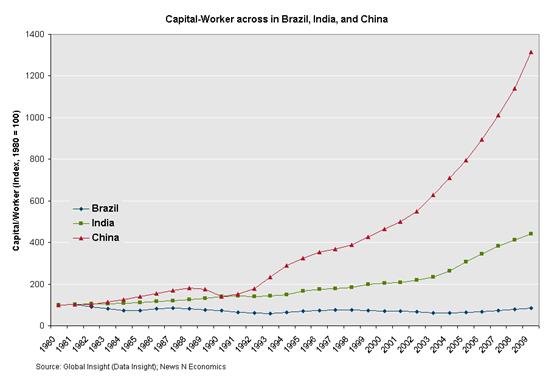 Capital per worker across emerging economies 1980-2009. Source: newsneconomics.com
Conclusively, although the prosperous Brazilian economy brings about several signs of future unsustainable growth, it is certainly a deal-breaker in the short run, especially given its non-capital investment in people and large openness to FDI. If the latter is to be fixed through more liberal reforms and more stable prices levels, the economy is still possesses undiscovered potential for years to come.
*Order and progress


But wanna remark on few general things, The website style and design is perfect, the written content is very good : D.