
Although the real Investment Fund activities are still yet to come, it is obviously worth reneving the tradition and publish weekly reviews on recent topics in macroeconomics and finance. Hence, for a little entertainment (and some enlightening information) enjoy the first weekly review of the new iFund board:
The hot summer seems to be at its peak not only with regards to weather but also as being a lively period in the financial markets. Nevertheless, the overall mood in the latter does not appear as bright as the sunny days of July. Stock prices do not intend to show any remarkable signs of growth (as seen from the latest developments of the S&P 500 index) and resemble more of a roller coaster whose passengers are heading into a periodical sequence of mountains and steep valleys below the 2010 closing price.
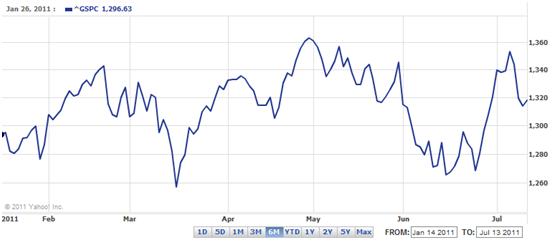
Development of the S&P 500 index. Source: finance.yahoo.com
The outlook for the forthcoming months looks even more gloomy, given the less optimistic projections for the growth of U.S. economy. This appears to have reasonable justification: as Wall Street’s analyst Daniel Henninger has successfully pointed out that the first quarter growth of 1.8% may become the upper-limit for the upcoming years of recovery. He cites the view of the Nobel-prize winning economist Robert Lucas that “the movement of American economy to the more European model by increasing welfare via higher taxes and social expenditure, the country is constrained to lower GDP growth in the next 25 years”.

Factory output has slowed down all over the globe and the Economist reports global growth as being the weakest in the last two years. This has even made the bright minds of the European Commission reconsider the early estimates of 1.8% EU GDP growth to a more modest 1.6% for the rest of the year. China and India also seem somewhat discrete in their growth figures, as the battle with surging inflation rates continues to leave a trace on the overall mood.
So, has the world economy accidentally fallen into a “sticky patch”, as The Economist calls it, or the situation may seem more severe than just some sort of economic nuisance?
For the time being, the
recent developments suggest that the current slowdown may be only a temporary phenomenon due to several reasons. First, the steady surge in oil prices in the beginning of the year had a severe effect on the world demand, especially in the gas-voracious America where consumer confidence shrank immediately and reflected in lower demand. Notable political events occurred in the Arab world which surely pushed oil prices upward. The US dollar could not have been left unaffected having jumped to a record high of 0.7704 in January, yet the unfavourable conditions in the Eurozone have forced the dollar to appreciate over the next 5 months. Since then the dollar has steadily helped the US to regain competitiveness and after small abysses still continues to depreciate against the euro. These may be the most indicative factors of the reanimation in the world’s most powerful economy (at least to date…).
The second reason can be unequivocally identified by anyone who has at least minimum awareness of what is happening in the world. Undeniably, the tsunami in Japan in March set the tone in the world financial markets for a temporary period. Plant shutdowns (such as those of Matsushita, Mitsubishi and Toyota), supply chain shortages and deficiencies as well as lower demand all were culprits of the swift slump in the Asian and ADR stock markets. The tsunami had its most notable projections in April, whereas currently the situation seems to be far more favourable in the Japanese industry given the renewed supply of car orders and increased summer production plans in their offshore plants. The NIKKEI 225 index is a fine indicator of the recent developments having gained more than 6% during the last month with visible prospects for future growth.
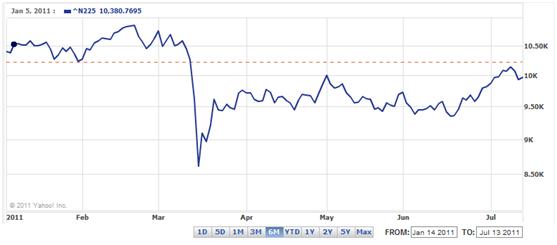 Movements of NIKKEI 225. Source: finance.yahoo.com
The third underlying reason is the monetary tightening of several emerging economies to offset the menaces of inflation. China saw its consumer prices rise by 6.4% in June, while India’s inflation picked up at 9.44% as compared to the previous year. The measures taken on by the countries may eventually start to lead to positive outcomes, yet monetary policies in those countries (China is becoming a growing concern of eventual hyperinflation) are still rather loose and more drastic actions should be taken.
Let us turn to more familiar grounds, namely, the European Union, where the situation deserved to be a lot better. “The recovery in the EU is weak and vulnerable, as it usually tends to happen after balance sheet crises,” says the Economist. And there is no reason that the situation may improve given the weakness of the periphery economies in Central and Eastern and ECB’s inability to control the rate of inflation. This may call for an increase in the base interest rates, which is what the ECB is planning to do over the course of July to dampen the inflationary effects.
The latter effect has also lead to some uncertainty among corporates all around Europe. Many prominent companies are sitting with a pile of cash and awaiting a possible overturn in the growth rates as well as a more acceptable interest rate. Of course it is logical of them not to invest immediately, rather than await and facilitating growth whenever there is reasonable need.
Overall, there is evident reason to think that the short-term sluggishness is likely to remain only a temporary phenomenon, permitting to paint a rather optimistic future picture of the global economy. Nevertheless, nothing is carved in stone, thus the actual outcome will exclusively be subject to important political decisions in the forthcoming months, leaving us with nothing than making our own educated guesses…
Note: Although Greece has been a focal player in bringing trouble to the crisis-weakened Eurozone, it may be of readers’ interest that I leave it out for a later article, perhaps in a special cycle about PIGS. Time will show.
Sources for inspiration:
http://finance.yahoo.com
http://www.seekingalpha.com
http://www.economist.com
http://online.wsj.com
http://ec.europa.eu


