
The first two weeks of studies have almost passed (or to say, rushed at a fast pace), the iFund board is working actively on attracting sponsors and working out several ways of how to renew our portfolio this year. Regardless of that, we have presented our organization to Y1 students, and as soon as the sign-up process is finished, we will carry on active cooperation with the newly members not to mention Y2s for which there will soon be an application process opened for several associate positions. Enough organizational matters, relax and enjoy the last issue of our BRIC countries cycle, with an extensive coverage of the emerging giant of the East – China.
China”s economy is huge and expanding rapidly. In the last 30 years, the rate of Chinese economic growth has been almost miraculous, averaging 8 percent growth in Gross Domestic Product (GDP) per annum. The economy has grown more than 10 times during that period, with Chinese GDP reaching 5.88 trillion US dollars in 2010. The last years’ growth is miraculous when the country quickly regained is fast pace of growth after a short-term slump, reaching an astonishing 9.5% year-on-year growth in the 2nd quarter of 2011 (see
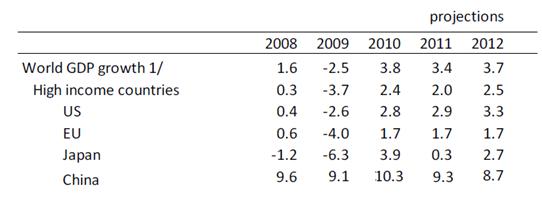
Real GDP growth rates comparison. Source: the World Bank
China already has the biggest economy after the United States and most analysts predict China will become the largest economy in the world this decade. The Economist predicts that such leadership change might occur somewhere in 2016-2017 or even faster given US’ huge prospects of a double-dip recession in the forthcoming half a year. Nevertheless, the country has already surpassed the US as the world’s largest manufacturer thereby representing a notable menace of dictating the pace of world economic growth in the nearest years.
China has boasted an incredible record of alleviating poverty, building industry, creating jobs, and translating economic power into political power. Speaking of the latter, the country maintains a peculiar form of state capitalism where the central government dictates much of the necessary processes as well as sets the tone for economic growth in the country.
Since China’s economy has grown so fast during the past few years, many multinational companies see an opportunity of serving a yet fully undiscovered market: the country”s most affluent urban customers. These consumers earn more than 100,000 renminbi (about $12,500) a year and command 500 billion renminbi—nearly 10 percent of urban disposable income—despite accounting for just 1 percent of the total population. They consume globally branded luxury goods voraciously, allowing many companies to succeed in China without significantly modifying their product offerings or the business systems behind them.
The source of China’s growth is more worrying than its speed. According to Mark Williams of Capital Economics, investment comprised 62% of the economy’s expansion in the second quarter, its biggest contribution for 18 months. Investment in fixed assets, such as buildings, factories and equipment, has grown by between 21% and 26%, year on year, for the past four quarters, despite the government’s efforts to tighten credit. This resilience may be because so much investment is carried out by state-owned firms, which are at the top of the pecking order when banks make loans. It may also be a sign that financing is not as tight as the hawks would like.
Whenever economists talk about China, contrary to the overrated optimism of many analysts they focus on the need to “rebalance.” That means China is too dependent on exports and investment for its growth, and needs to increase the private consumption and savings rates, which atlhough are very high as compared to the Chinese income (reaching around 40%), they still significantly lag behind the advanced economies in nominal terms.
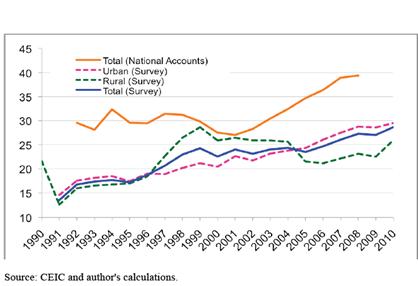
Chinese savings rates. Source: macrobusiness.com.au
Private consumption in China is also revealing pessimistic patterns:
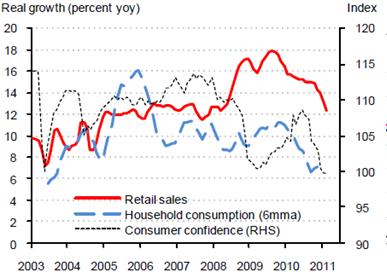 Chinese savings rates. Source: the World Bank
A leading developmental academic warned that China’s initial, stimulus-fuelled success in rebounding from the global financial crisis – in contrast to the sharp slowdown in the west – should not lead economists and policymakers in other parts of the world to view the China model as a workable future growth model. „All what the Chinese did is pump banks with excess liquidity that could further be used to finance corporations and consumers. And now the implications are becoming blatant: high inflation, cost of living, surging housing prices, … So China is heading towards a lot of problems and its growth model needs fixing”. Unless there were widespread market reforms in China the country would face widespread internal dissatisfaction and the prospect of a significant growth slowdown, with profound implications for the global economy.
The concerns are somewhat ustified given how high the price level growth has been in the past months. In July the country experienced the highest rate of inflation in the past three years. Elevated inflation shows that China is still dealing with the after-effects of an unprecedented monetary expansion during the last global slump and may have limited room for more stimulus. So, if the monetary effect has depleted itself, China does not possess reasonable instruments to stabilize its economy. The exchange rate is undervalued, the budget deficit is reasonably large to deter fiscal stimulus, and interest rates cannot be prevented from rising. Is the country really heading for a mere crash in the forthcoming years?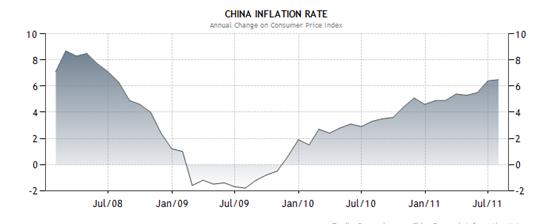 Chinese Inflation Rate. Source: tradingeconomics.com
In addition to the most notable flaws in the Chinese economy, there are also some peculiar features that are worth being noted. According to the recent research conducted by the global factoring company „Coface”, 74% of companies in China reveal an extremely weak payment discipline with an expectation of future prospects to deteriorate quite dramatically. The following fact is mainly due to China’s transition to the adoption of international payment standards in order to increase competition in the field of credit payments. On the other side, Chinese companies are usually the ones that face notable problems with cash flows and repayments, therefore facing relatively high risks of default. The representatives of „Coface Latvia” stress that having a sound corporate payment discipline is crucial in establishing solid business relationships as well as sustainable growth. As a matter of fact, the matter is becoming increasingly important to investors for making investment decisions as nobody would like their company to default on their inability to pay their rolling expenses.
Despite the fact that China’s GDP per capita is around $7000 and there are many human rights issues, the country’s massive size, the ease for making decisions under the non-democratic regime, and its economic potential has helped it to become one of the world’s most influential countries with its powers still rising rapidly. Western countries have invested heavily in China, but now that it’s becoming even more open even new opportunities emerge; thus making China one of the major players in the financial world.

