
Ever since the outbreak of capitalism in the world economy the United States have taken a somewhat peculiar position as the advocate of the correct “way of living” and an exemplar community. U.S. leaders have believed in the concept of American exceptionalism, that the U.S. is a special country with a special mission. It is a notion that continues to this day. And as Michael Schuman of TIME magazine successfully points out, “when it comes to the threat its deteriorating national finances present to the world economy, the U.S. is truly exceptional”.
How come the most powerful nation is starting to reveal its weaknesses by not being able to make its ends meet (and have unmolestedly done that for more than 30 years) when the country consistently predominates in the military and political life of the world? I guess this question is out of reach for the scope of this article, yet it may shed light on what could happen in the forthcoming future. Many experts claim America will not default, yet they seconded S&P’s anticipations to downgrade the future outlook for the US. However, for the western society and financial markets the news of the recent weeks have indicated that the terrifying consequences of America’s debt problem may put the financial markets into much deeper agony than EU’s
euro-saving operations, Japan’s 20-year slump and the credit crunch altogether.
For starters it is worth sketching the overall picture of the shaking situation Americas has gone into. The US has had public debt since its inception in 1776, experiencing major ups and downs in the levels of debts. There were periods when public debt grew by 2500% (as it was during the war periods) and when the governments pushed the levels of debt to only 0.3% of GDP. Those were the times when huge budget and current account surpluses were purposefully run to offset the menaces of rising indebtness.
Nevertheless, the latter issue of creating a steady budget as well as a current account surplus has been a major problem for Americans throughout the last century. The main tribute goes to the presidencies of Ronald Reagan and George Bush S., whose loosened tax policies and a relieved environment for investment created huge capital inflows from abroad to ultimately finance the American companies via buying their bonds and debentures. The private sector also revived thanks to “Reaganomics” and started to voraciously consume foreign, as seen by the negative net exports for the past 30 years. Meanwhile, the government also allowed for a feast, via issuing Treasury bonds to maintain the carnivorous level of consumption it had at that time. The graph illustrates the differences between the expenses and proceeds for the US Federal government.
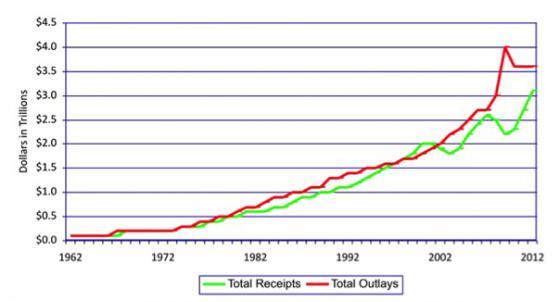 US Federal Government receipts and outlays 1962-2012. Source: Reuters EcoWin
Over the last decade reversing actions by the Bush administration has been taken to reduce the level of debt via increased taxes and more severe financing regulations and bank monitoring. Initially, this even helped to halt the rate at which the debt was growing, though everybody knows how the “thorough financial market” monitoring programme worked. The 5 years of abundance during the credit boom fostered the public debt, reaching a level of 83% of GDP in 2010.
Last week our the world exhaled in relief due to the government’s emergency action to raise the debt ceiling. Yes, they were so close (missed by a mere 25 Million), but raising the debt ceiling will not solve the problem and more drastic budget planning measures should be taken. In the meantime, we can only observe what the government will do about the debt problem and One of the which were outlined within the FBI records incorporated 2008 football between your College of Oklahoma and Kansas College, Texas and Missouri, and Penn Condition and Ohio Condition. see the debt growing (by the way, usdebtclock.org allows to track the real time changes of the US debt).

Current value of debt. Source: The Economist
So what is currently happening in the biggest stock markets? To the utmost surprise the stock appear to ignore this striking news as if nothing had happened. Last week the S&P index closed at 1344.26, more than 25 points above the Monday opening price (a gain of 1.8% in just a week), and other major indices such as NASDAQ and DJIA have replicated such a development pattern. It appears that such phenomena have happened with reasonable frequency, with a nearly identical situation happening in the mid-nineties when stocks showed up a considerable increase while the federal government rushed to alter the debt ceiling of the country.
Where is the train heading?
The Federal Reserve has argued that “congressional gridlock (failure or hesitation to reach agreement on debt ceiling) will show significant uncertainty in the government and corporate bond markets and place upward pressure on interest rates”. They warn that the increase would not only raise future borrowing costs of the federal government, but would also raise capital costs for struggling U.S. businesses and cash-strapped homebuyers (who are still inactive after the mortgage crisis). This only implies that in the forthcoming months there will be more precaution from companies with regards to capital investments or some projects could be frozen. Hence, a there will be a similar situation to that of European corporates who sit on large chunks of money and awaiting the next occurrences in the EMU saving process.
Furthermore, investment banks have long warned the government of taking respective drastic precautionary action unless the government succeeds in raising the debt ceiling. “I would hope it gets resolved,” and official of JP Morgan says. “If the United States actually defaults on our debt it would be catastrophic… and unpredictable. “All short-term funding would disappear.”
Turning away from America, what could be the visible implications to the rest of the world? Undoubtedly, the greatest losers will be the countries that have had a long standing reputation of being America’s most generous lenders. And the lucky trio is the unpredictably fast-growing China, deficit-weakened United Kingdom and catastrophe-devastated Japan, who altogether own almost 40% of the US debt. Adverse outcomes of America’s debt problem would clearly have visible projections in these countries as well as swiftly transpose to the countries that are in close relation to the “deadly” trio. And this may only indicate a start of a huge snowball effect that may lead the financial markets into a deeper turmoil.
Much concern is placed upon the government’s efforts by trying to lower the debt via inflation tax. Already now the Fed has been relentlessly printing money as if there is no tomorrow: in the recent quantitative easing (a trendy term for money printing) session alone, the Federal Reserve System issued nearly 1 trillion dollars, which would consequently transpose into higher inflation, and thus relatively “cheaper debt”. However, this is being done on the account of the consumer who will eventually absorb the adverse effects of lower purchasing power via smaller real wages. If the US defaults more such painful steps are yet to be taken and it will all lie as an additional burden to the US society.
Useful sources:
http://www.treasury.gov/connect/blog/Pages/letter.aspx
http://blogs.wsj.com/washwire/2011/03/30/dimon-hitting-debt-ceiling-would-be-catastrophic/
http://www.cfr.org/international-finance/us-debt-ceiling-costs-consequences/p24751#p6

